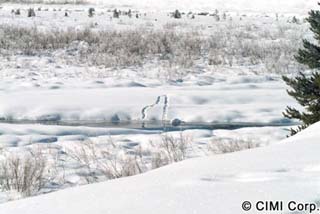
 OK, see that stuff on the ground above? It’s snow, obviously. Snow means a lot of things to photography, and most of them are bad. The Yellowstone trip was the first really cold weather trip I’d taken with a serious photographic mission, and not surprisingly I learned a lot of interesting things.
First, when the temperature gets below freezing, camera batteries die very quickly. At about 10 degrees, it’s nearly impossible to keep a digital camera running unless you warm the camera, the batteries, or both. Everybody has an approach to this problem, but here are the things I found were workable:
1. If possible (meaning if the camera supports it and you can afford it), buy an external battery pack that links to the camera via a cable. Get a cable long enough to snake out of your clothing, and keep the battery in an inside pocket where it’s warm. A videographer who accompanied me on this trip was smart and did this. I wasn’t, and didn’t.
2. If you don’t have a separate, warm, battery pack, keep the camera body warm when you’re not shooting. Some will advocate putting it inside your clothing, but that will only work if you don’t have the camera exposed long enough to get really chilled. If you do, not only will putting the camera inside your clothing be like taking an ice cube to bed, it will probably generate lots of condensation on the camera. Take care, in other words. It’s probably better to hold the body, particularly the battery area, in your gloved hands while not shooting. Above all, don’t leave the camera on a long lens sitting on a tripod sitting on ice! The process leaches the heat out in nothing flat, and flat is then what the batteries will be.
3. Carry an extra couple of sets of batteries in a warm place, and switch them if things get cold. If the camera uses two battery types (as the S2 does) be prepared to switch both.
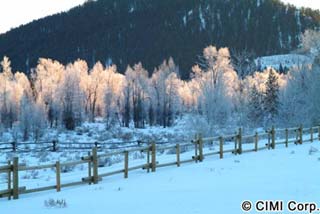 Another problem with these conditions is the blowing snow/ice crystals that you’ll encounter. Every breeze generates a zillion tiny lens spots just looking for a place to roost, and when they hit the lens they’ll likely melt to form micro water spots that you’ll not see till you’re processing your stuff. Keep the lens cap on, get an elastic jar cover to fit over the lens hood, or wipe the lens with a lens tissue regularly to avoid this problem. If the temperatures are fairly low (below about 25 degrees F) the chances are that snow or ice on the camera body or lens barrel won’t stick. If it’s warmer, you may get melting on contact with the camera, so you’ll probably have to blow the stuff off continually or cover the camera with something while outside.
Changing lenses is a fact of life everywhere, and particular with digital cameras whose cost is high enough to discourage carrying multiple camera bodies. When you change a lens, you’ve got to take the old one off and put the new one on, obviously. Less obvious is the fact that this process will leave a hole in the bottom of the old lens, which used to stick into the camera, and will also leave a hole in the camera for the time it takes to change. All kinds of stuff will be magnetically attracted to these holes, and on entry will either gum up things or make an appearance in your subsequent pictures as blurs and specks. Try to change in a sheltered spot, and mark those rear lens covers with a dot of nail polish or something so you can see how to quickly align them on the lens. Hold the camera body with the lens side facing down when no lens is attached.
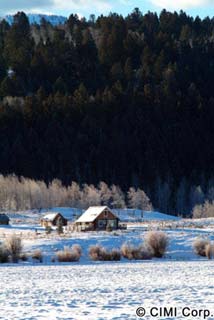 When you’re ready to leave the field, put all the gear in the cases or in plastic bags and keep it there until the stuff has had a chance to warm up to room temperature, to avoid condensation. If the environment you’re going into is not particularly warm and moist, you may not have a problem. To determine if you will, keep a small square of metal (stainless steel, if you have it) in a mesh compartment on the outside of your gear bags and watch that to see if stuff condenses on it when you change locations. If it does, it’s not safe to remove the photo gear from the bag.
Exposure in snowy conditions is tricky. Matrix metering on most cameras will be fooled by the preponderance of white and will usually underexpose the scene unless you compensate. Spot metering on the subject may burn the snow to pure white on the output. Look at the image or (if available) the histogram, of a test shot to check exposure. When you can’t be sure, try overexposing a full stop versus the metered setting. Remember, the S2 will give you compensation latitude on conversion if you use the Fuji Raw Converter EX package (which I recommend strongly).
Tom’s photo-tips are Copyright © CIMI Corporation, and adapted from his posting on his website at http://www.cimicorp.com/DI/DINav.html. Used by permission..
